

Embracing Digital Transformation for Member Success
Member based organisations face unprecedented pressure to modernize their operations and meet evolving member expectations. The integration of IT and AI technologies presents a transformative opportunity that goes far beyond simple digital upgrades. When strategically implemented, IT and AI can revolutionize how member organisations operate, engage with their communities, and deliver value.
The landscape of membership has shifted dramatically over the past few years. Members now expect seamless digital experiences, personalized interactions, and responsive support. Organizations that fail to adapt risk losing relevance and members to more innovative competitors. The good news is that technology has evolved to make these transformations achievable and affordable for organizations of all sizes.
IT and AI work together to create powerful synergies that address core operational challenges. From automating routine administrative tasks to providing deep insights into member behavior and preferences, these technologies offer concrete solutions to real business problems. The key is understanding how to leverage them effectively within your unique organisational context.
This blog post explores seven proven strategies for integrating IT and AI into member organisations. Each approach has been tested in real-world environments and demonstrates measurable benefits. Whether you are just beginning your digital journey or looking to enhance existing initiatives, these insights will help you unlock new possibilities for member engagement and organisational growth.
1. Understanding the Synergy Between IT and AI Integration
The power of IT and AI lies in how they complement and amplify each other. Information Technology provides the foundational infrastructure, systems, and processes that keep organisations running smoothly. Artificial Intelligence adds intelligent automation, predictive capabilities, and personalized experiences on top of that infrastructure.
Think of IT as the skeleton and AI as the nervous system of a digital organisation. The skeleton provides structure and support, while the nervous system enables responsiveness and intelligent decision making. When both work in harmony, organisations can achieve remarkable operational efficiency and member satisfaction.
Many member organisations initially view IT and AI as separate investments. This compartmentalized thinking leads to missed opportunities for integration. Forward thinking leaders are recognizing that the greatest value comes from viewing these technologies as complementary components of a unified digital strategy.
Key integration benefits include:
- Automation of complex workflows that involve both data processing and intelligent decision making
- Predictive analytics that anticipate member needs before they arise
- Personalized experiences delivered at scale through intelligent systems
- Real time insights that inform strategic decisions
- Reduced operational costs through intelligent process optimization
The synergy becomes apparent when you consider a practical scenario. An IT system manages member data and interactions. An AI system analyzes that data to predict which members might be at risk of leaving. Together, they enable proactive retention campaigns that would be impossible with either technology alone.
This foundational understanding of IT and AI integration sets the stage for the specific transformation strategies that follow. Organisations that grasp this synergy are better positioned to make strategic technology investments that deliver measurable results.
2. Streamlining Operations with IT and AI Solutions
Operational efficiency is a critical concern for member organisations. Many still rely on legacy systems and manual processes that consume significant time and resources while introducing errors. Modernizing operational workflows through IT and AI delivers immediate and measurable improvements.
Specific operational improvements include:
- Reducing processing times by 60 to 80 percent through intelligent automation
- Minimizing human error in routine administrative tasks
- Improving compliance and audit trails through automated logging
- Enabling staff to focus on high value member interactions rather than data entry
- Creating consistent processes across multiple departments and locations
Consider member onboarding as a practical example. Traditional approaches require manual data entry, verification steps, and multiple handoffs between departments. An integrated IT and AI system can automate data capture, perform instant verification checks, and route members to appropriate resources automatically.
Payment processing represents another area where IT and AI improvements deliver significant value. Automated systems can process recurring payments, flag suspicious transactions, and reconcile accounts without manual intervention. This reduces administrative overhead while improving cash flow predictability.
Member communications benefit tremendously from operational improvements. Rather than sending generic newsletters to all members, IT and AI systems can segment audiences, personalize content, and optimize send times based on individual member behavior patterns. This increases engagement rates while reducing the workload on communications teams.
Organisations implementing these operational improvements typically report significant cost savings within the first year. More importantly, staff satisfaction increases because teams can focus on meaningful work rather than repetitive administrative tasks. Members also notice the difference through faster response times and fewer errors in their interactions with the organisation.
3. Enhancing Member Engagement Through Intelligent Technology
Member engagement is the lifeblood of any membership organisation. Technology that improves engagement directly impacts retention, member satisfaction, and lifetime value. IT and AI enable engagement strategies that were simply impossible before.
Personalization at scale is one of the most powerful applications of IT and AI for engagement. Rather than treating all members identically, intelligent systems can customize experiences based on individual preferences, behavior patterns, and demographics. A member interested in sustainability might see different content and event recommendations than a member focused on professional development.
Engagement enhancement strategies include:
- Personalized content recommendations based on member interests and behavior
- Targeted communication campaigns timed for maximum relevance
- Proactive outreach to members showing signs of disengagement
- Intelligent event recommendations based on member profile and attendance history
- Customized learning paths and resource suggestions
- Predictive identification of high value member segments
Digital community platforms powered by IT and AI create spaces where members can connect, collaborate, and find value beyond traditional offerings. These platforms use AI to surface relevant connections, recommend discussion topics, and identify emerging areas of interest.
Mobile app experiences have transformed member engagement for forward thinking organisations. Apps deliver personalized content, enable easy event registration, facilitate member to member connections, and provide instant access to member benefits. AI powers the recommendation engines and personalization that make these apps genuinely valuable.
Member feedback collection and analysis has become vastly more sophisticated with IT and AI. Rather than simply aggregating survey responses, intelligent systems can identify sentiment trends, predict satisfaction levels, and recommend interventions. This enables organisations to address problems before they affect member retention.
The engagement improvements from IT and AI integration result in higher member satisfaction scores, longer tenure, and increased spending on additional services and products. These metrics directly influence organisational financial health and sustainability.
4. Improving Data Management and Predictive Analytics
Data represents one of the most valuable assets a member organisation possesses. Yet many organisations struggle to harness this asset effectively. Improved data management combined with predictive analytics enables decisions based on evidence rather than intuition.
Member organisations typically accumulate vast amounts of data spanning member demographics, engagement history, transaction records, event attendance, and communication preferences. This data remains largely underutilized in organisations lacking proper IT infrastructure and analytical capabilities. IT and AI systems transform this data into actionable insights.
Data and analytics applications include:
- Segmentation of member populations based on hundreds of variables
- Prediction of member churn risk with high accuracy
- Identification of members most likely to adopt new services
- Revenue forecasting based on historical patterns and current trends
- Trend identification indicating emerging member interests
- Correlation analysis revealing unexpected relationships in member behavior
Predictive analytics enables proactive strategy rather than reactive crisis management. Rather than waiting for members to leave, organisations can identify at risk members and implement targeted retention programs. Rather than discovering new opportunities through accident, organisations can identify emerging interests before they become obvious to competitors.
Data governance becomes critical as organisations accumulate and analyze more member data. IT systems establish controls ensuring data accuracy, consistency, and security. Compliance with regulations like GDPR becomes easier when proper IT systems enforce data protection protocols.
The investment in proper data infrastructure and analytical capabilities typically pays for itself through improved decision making and operational efficiency. More importantly, it positions organisations to adapt quickly to changing member preferences and market conditions.
5. Automating Routine Processes and Administrative Tasks
Administrative workload represents a significant cost center for most member organisations. While this work is necessary, it provides little value to members. Intelligent automation through IT and AI eliminates this burden, freeing resources for activities that directly benefit members.
Routine processes suitable for automation include membership renewals, payment processing, membership level changes, certificate generation, and status updates. These processes follow predictable patterns and do not require human judgment. Automation improves speed, consistency, and accuracy while reducing costs.
Automation opportunities include:
- Automatic renewal reminders and processing of renewal payments
- Instant member verification and status confirmation
- Automatic generation and delivery of certificates and credentials
- Routine compliance reporting and audit preparation
- Appointment scheduling and reminder communications
- Invoice generation and payment processing
- Automated data backup and security protocols
Email management becomes dramatically more efficient with automation. Routine inquiries like password resets, membership verification, or event details can be handled through intelligent chatbots or automated email responses. Human staff can focus on complex inquiries requiring judgment and personal touch.
Report generation, a time consuming task in many organisations, can be fully automated. Systems can gather data from multiple sources, calculate metrics, format results, and distribute reports on schedules. This enables more frequent reporting without additional staff effort.
The time savings from automation are substantial. A team member might spend 10 to 15 hours weekly on routine tasks that could be automated. Across an organisation, this represents significant capacity that can be redirected toward member value creation.
Member experience improves through automation as well. Routine requests are handled instantly rather than waiting for staff availability. Members receive faster responses and more consistent treatment. This combination of cost reduction and experience improvement makes automation an obvious investment priority.
6. Building Scalable Systems for Sustainable Growth
Member organisations aspiring to growth need systems that scale with them. Traditional approaches built on manual processes and disconnected systems reach capacity quickly and become increasingly fragile. IT and AI enable scalability that supports growth without proportional increases in overhead.
Scalable systems share common characteristics. They handle increasing data volumes without performance degradation. They support growing numbers of users and interactions. They maintain data consistency and accuracy across expansion. They enable new capabilities and services without complete system redesigns.
Scalability benefits include:
- Support for significant member growth without infrastructure overhauls
- Addition of new services and programs through modular system design
- Geographic expansion enabled by cloud based infrastructure
- Multi language and multi currency support for international expansion
- Capacity to handle seasonal spikes without service disruption
- Foundation for future innovation and technology adoption
Cloud based infrastructure provides the foundation for true scalability. Rather than managing physical servers with fixed capacity, cloud systems grow and shrink based on demand. This eliminates the need for expensive upfront infrastructure investment and enables rapid scaling as the organisation grows.
Modular system architecture enables growth in capabilities without complete system replacements. New features and services can be added through integration with existing systems rather than requiring replacement of functioning technology. This approach reduces costs and minimizes disruption during growth phases.
API based architecture enables third party integrations and custom capabilities specific to your organisation. Rather than being limited to standard functionality, you can extend capabilities as unique needs emerge. This flexibility becomes increasingly valuable as organisations grow and specialise.
Organisations with scalable IT and AI systems in place can pursue growth opportunities confidently. Whether expanding to new geographic regions, adding new membership categories, or launching new services, the underlying technology infrastructure supports these ambitions without requiring complete overhauls.
7. Enhancing Decision Making Through Intelligent Insights
Member organisations face complex decisions involving strategic direction, resource allocation, and member value proposition. Decisions made with better information and deeper insights produce better outcomes. IT and AI deliver the intelligence needed for superior decision making.
Executive dashboards powered by IT and AI provide real time visibility into organisational performance. Rather than waiting for monthly reports, leaders can monitor key metrics continuously. Anomalies and trends become immediately apparent, enabling rapid response to emerging challenges or opportunities.
Decision enhancement capabilities include:
- Real time performance dashboards showing key metrics and trends
- Scenario modeling enabling evaluation of potential decisions before implementation
- Benchmarking against industry standards and peer organisations
- Predictive modeling indicating likely outcomes of strategic choices
- Customer analytics revealing what drives member satisfaction and retention
- Market trend analysis indicating where the organisation should focus attention
Competitive analysis becomes more sophisticated with AI powered tools. Rather than relying on periodic manual reviews, organisations can monitor competitor activities continuously. Alerts notify leadership of significant competitive moves, enabling faster strategic response.
Member preference analysis helps organisations prioritize where to invest resources. AI can process member feedback, behavior patterns, and stated preferences to identify what matters most. This prevents wasted investment on features or services members do not value while ensuring focus on high impact improvements.
Financial forecasting improves dramatically when powered by historical data and advanced analytics. Rather than relying on simplified assumptions and manual estimates, AI models incorporate dozens of variables and historical patterns to produce more accurate predictions. This improves budget accuracy and enables better financial planning.
The competitive advantage from superior decision making is substantial. Organisations that understand their members, market, and operational realities better than competitors make better strategic choices. Over time, these superior decisions compound into significant competitive advantages.
Finally: Managing Technology Implementation and Change Successfully
Understanding the benefits of IT and AI is one thing. Successfully implementing these technologies is another challenge entirely. Many technology implementations fail not because the technology is inadequate but because organisations struggle with change management.
Successful implementation requires clear vision and committed leadership. Executive sponsorship ensures resources are allocated appropriately and organisational priorities align with technology investments. Leadership visibility demonstrates importance and builds momentum for change.
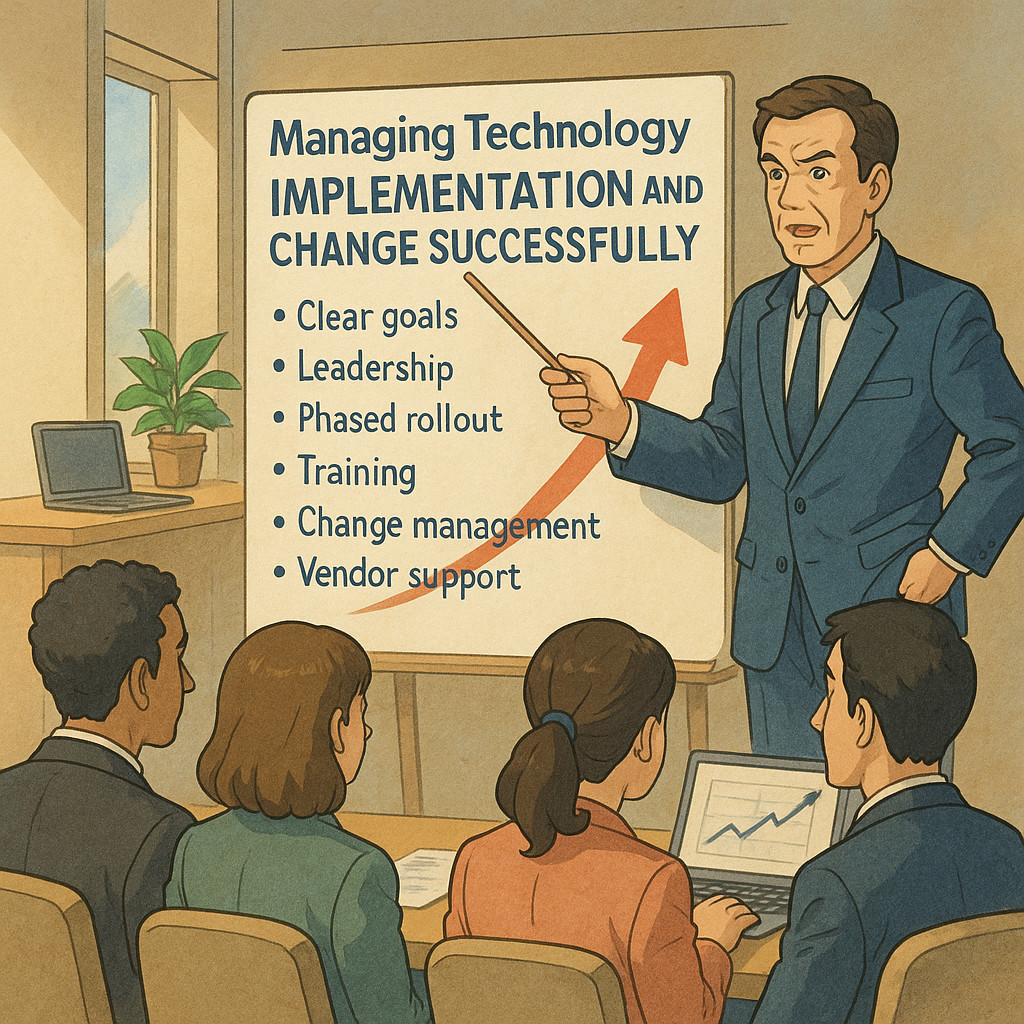 Implementation success factors include:
- Clear articulation of desired outcomes and success metrics
- Strong executive sponsorship and leadership commitment
- Phased implementation reducing organisational disruption
- Comprehensive training ensuring staff competency with new systems
- Change management programs addressing emotional and cultural aspects
- Vendor partnership ensuring ongoing support and optimization
- Monitoring and evaluation enabling course corrections
Choosing the right technology partners matters significantly. Vendors with experience in member organisations understand unique requirements and challenges. Look for partners with proven track records in your sector and commitment to customer success.
Staff training and support are critical success factors. New systems require new skills and ways of working. Comprehensive training programs ensure staff understand not just how to use systems but why these new approaches are valuable. Ongoing support during the transition period addresses questions and builds confidence.
Cultural change often proves more challenging than technical implementation. Staff accustomed to familiar processes may resist new approaches. Communicating benefits, involving staff in implementation, and celebrating early wins help overcome resistance and build enthusiasm for change.
Phased implementation reduces risk compared to big bang approaches. Starting with one department or one process enables refinement before expanding to the entire organisation. This approach identifies and resolves problems at smaller scale before they affect the entire organisation.
Conclusion: Transforming Your Member Organisation Today
The integration of IT and AI represents one of the most significant opportunities available to member organisations today. The benefits span operational efficiency, member engagement, strategic decision making, and scalability. Organisations that embrace these technologies position themselves for sustainable growth and competitive advantage.
The seven strategies explored in this blog demonstrate that transformation is achievable for organisations of all sizes. You need not adopt all strategies simultaneously. Starting with areas offering the clearest benefits and building from there creates momentum and demonstrates value that builds support for broader transformation.
The member organisations achieving the greatest success with IT and AI share common characteristics. They have clear vision for how technology serves member needs. They invest in change management and staff development alongside technology. They partner with vendors who understand their unique challenges. They measure results and continuously optimize their approaches.
The competitive landscape is changing rapidly. Member organisations that delay their digital transformation risk falling behind competitors who are already realizing these benefits. Yet the transformation journey need not be overwhelming. Breaking it into manageable phases, learning from experience, and building on early successes creates sustainable progress.
Your organisation's IT and AI transformation journey starts with clarity about objectives, commitment to change, and willingness to learn and adapt. The payoff comes through improved operational efficiency, engaged members, data driven decisions, and sustainable growth. The time to start this journey is now.
External Links Used:
- McKinsey UK Artificial Intelligence Research - https://www.mckinsey.com
- British Standards Institution Digital Services - https://www.bsigroup.com
- Association of Professional Bodies in the UK - https://www.aupb.co.uk
- Government Digital Service Standards - https://www.gov.uk/guidance/government-digital-service